Graduate Student Training Program
Gain leadership and scientific communication skills while contributing to Melbourne Bioinformatics
Participating in the Melbourne Bioinformatics Training Program has been one of the most transformative experiences of my PhD so far. Renee Papaluca, 2025 cohort
Overview
The Melbourne Bioinformatics training program is a year-long, paid opportunity for students to learn about and contribute to the growing field of knowledge in bioinformatics as well as develop their leadership and scientific communication skills. Students will then be able to apply these skills as workshop facilitators and leads throughout the program.
Learning Objectives
- Develop proficiency in programming languages commonly used in bioinformatics (e.g., Python, R)
- Design effective learning outcomes and create engaging material for bioinformatics workshops
- Develop skills in explaining complex bioinformatics concepts to diverse audiences
- Develop project management skills, including planning, time management, and resource allocation
Eligibility
-
Participants in the program must be current graduate students (inc. Master's by
coursework students) in good standing and enrolled at the University of Melbourne.
- Students who are “at risk” status, awaiting a CAPC meeting, or subject to a points restriction on subject enrolments are not eligible to apply.
- Applicants should be available for in person attendance throughout April to early December of the application year
Selection criteria
Some previous git and R experience are essential, but fluency is not required for entry into the program. If offered a place in the program, successful participants must submit relevant documents to the training lead upon acceptance:
Current Master’s students must submit a current Statement of Results and, if currently enrolled a research project subject, submit written permission from their research project supervisor.
Current PhD students must submit written permission from their primary supervisor. Students may submit their thesis during the duration of the program as long as they are able to fulfill their obligations to the program. Students must be able to attend in-person workshops and meetings throughout the year.
Time Commitment
You will be expected to spend between 30-50 hours throughout the duration of the program on meetings, training activities, and workshop facilitation/leading. The program is designed to be intentionally flexible to accommodate demands on students’ time from coursework classes, assessments, research activities and meetings with supervisors. Breaks/holidays can also be accommodated as part of the program. However, any planned extended break (1+ months) should be discussed with the training lead.
Program associates will be expected to facilitate/assist at least 2 workshops as well as lead at least 1 workshop by the end of the program. The workshop you lead can be content which has already been developed by Melbourne Bioinformatics or can be developed by you based on your own research or a relevant area of your expertise. Topics for workshop development will be discussed with successful applicants.
Timeline of Program
- February
-
Applications open
- March
-
Applications are reviewed and offers are extended
- April
-
Program officially starts
- May
-
Initial training activities take place
- June
-
Facilitation of workshops
- July
-
Continued training in workshop development and draft proposals
- August
-
Additional facilitation and workshop development
- September
-
Training activities and workshop development
- October
-
Finalisation of student-led workshops
- November
-
Workshops take place
- December
-
Program officially ends
Note: dates may be subject to change year-to-year
Testimonials
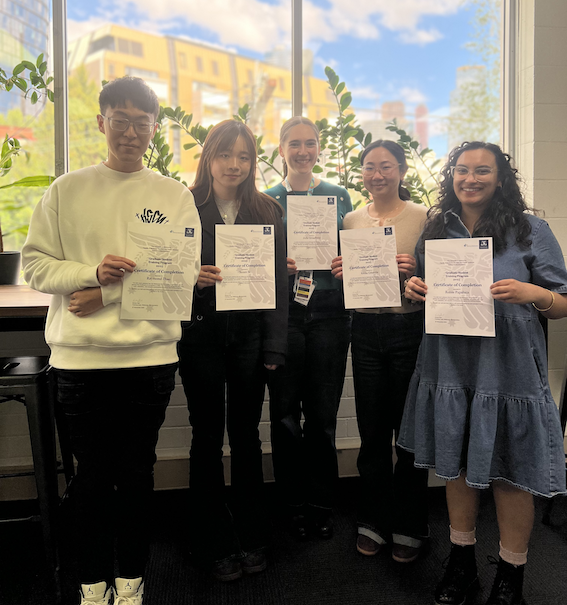
Find what our most recent (2025) cohort had to say about their experience in the program below:
The training program has been incredibly fruitful. The program lead and all staff involved have put in their best efforts to ensure that everything ran smoothly and was as educational as possible. I gained many valuable skills throughout the program. For instance, it helped me further develop my skills in R, Unix command line tools, and Git. Even when I encountered tasks I had never done before (such as workshop rendering), I was able to receive timely support from the program lead and staff to ensure that I stayed on track. One of the most rewarding parts of the program was meeting like-minded peers and having the opportunity to deliver a final workshop to participants ourselves. This experience helped strengthen my confidence and allowed me to understand bioinformatics concepts from a new perspective. I learned many other valuable things through this program, but to keep it concise, I can confidently say that it is absolutely worth joining. It not only broadens your academic and technical skills, but also helps y ou develop strong transferable skills. Special thanks to Emma, Steven, Tristan, Vini, and all my fellow co-trainees for making this a memorable and meaningful experience.
Raymond Zhao
Participating in the Melbourne Bioinformatics Training Program has been one of the most transformative experiences of my PhD so far. Coming from a wet-lab background, I entered the program with limited computational training, and MBITE provided exactly the structure, support, and confidence I needed to bridge that gap. I came in as someone who was “bioinformatics-curious” but intimidated by coding, and I’m leaving with confidence, practical skills, and a genuine excitement for computational biology. The trainers created such a supportive environment - patient with every question, generous with their time, and always encouraging us to explore and problem-solve. I especially loved how the workshops built progressively so I never felt truly lost, just steadily more capable. I now use R and pathway analysis tools routinely in my PhD, and I can’t believe how far I’ve come in a few months. I would recommend this program to any student wanting to build real, usable bioinformatics skills.
Renee Papaluca
As a bioinformatics student, Melbourne Bioinformatics workshops has given a fun and hands-on way to dive deeper into topics outside of class, and helped me meet people who share the same interests. I was really grateful to join the Train-the-Trainer program as it gave me the chance to see how everything works behind the scenes and to give back to the community that supported me when I was first learning. During the program, we picked up lots of useful skills, like how to design engaging workshops and how to use templates such as the Carpentries Workbench t o develop fun and interactive workshop material. We also got the chance to help facilitate a couple of workshops before eventually running our own. As someone who always gets nervous giving presentations, the program really helped to boost my confidence and I felt supported every step of the way.
Susan Si
It’s an amazing program! I gained a better understanding of different bioinformatics tools that would significantly enhance my research!!
Kezia Giatreja
Through the Training Program, I gained valuable skills in science communication and advanced my programming knowledge. It was great to become more familiar with the staff and resources available at Melbourne Bioinformatics. The time commitment was very manageable, I would definitely recommend any student completing a bioinformatics PhD to apply!
Julia Broadbent
For more information, please contact us via the information available on the Melbourne Bioinformatics main page:
Applications for the 2026 cohort are currently open! Applications close 6th March 2026.
Please note that you must be logged into your University of Melbourne account for form access. If you are associated with an affiliated institute, you may not be able to fill in the form if you are not logged in to your university student account. Log out of your institutional account and login via your student email account for form access. If you are still encountering an error, please email our training email for further assistance.
Special thanks
This program has been funded by the MDHS Graduate Research Development grant.